The major industrial project rising outside Godey, linked to Dangote Industries Limited, was introduced as a symbol of development, investment, and economic opportunity. It was presented as a project that would create employment, empower local businesses, and open a new chapter for the people whose land would host it. Yet what is unfolding on the ground has produced a very different public reaction, shaped by anger, disappointment, and growing resistance from a community that increasingly feels excluded from decisions directly affecting its future.
From the beginning, residents were told that local people would be given priority in employment, administration, security work, and service contracts. The understanding within the community was clear, if land is taken from local families, then the first beneficiaries should be the people who sacrificed that land. But once implementation began, those expectations quickly collided with a different reality.
The first groups of workers arriving at the site were brought from outside the region. Local residents say that even basic positions, including site guards and support workers, were filled by outsiders. This immediately triggered strong reactions across the town, because many saw it not simply as an employment issue, but as a message that local people were not trusted even on land taken from their own families.
The anger deepened when local companies discovered that they had been excluded from participation, while contractors from other regions, particularly companies brought from Addis Ababa, were positioned to take over major parts of the work. For many in Godey, this crossed a political line. Intellectuals, elders, business people, and even sections of the local administration expressed one common view, that a city with its own capable people, contractors, and professionals cannot accept being bypassed while outsiders are brought in to control economic activity on its own soil.
This opposition did not remain private. Public anger grew to the point that when outside workers attempted to proceed, local resistance forced a temporary halt, and companies brought from outside the region were prevented from continuing freely. Residents openly rejected the idea that while they remain present, organized, and capable, other firms should be imposed on them without consultation.
At the center of the grievance is land. Families whose farms and grazing areas were taken for the project say they have still not received fair compensation. Some households have already lost productive farmland without any settlement matching the value of what was taken. For a community whose livelihood depends heavily on land, this is not seen merely as an economic issue, but as a direct violation of dignity, ownership, and basic rights. The feeling spreading across Godey is that land can no longer be taken in the name of development while those who lose it remain empty handed.
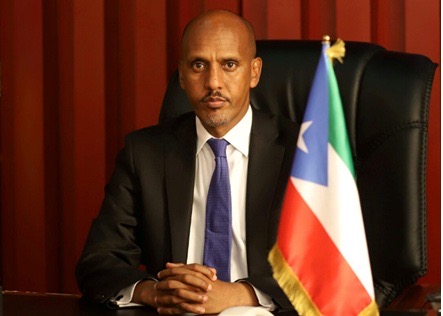
Many residents now argue that the regional government has failed in its first responsibility, protecting the rights of its own people. Criticism has increasingly focused on Mustafe Mohamed Omar, with widespread local belief that his administration does not exercise independent authority when major federal interests are involved. In public discussion across Godey, one perception dominates, that decisions affecting the region are made elsewhere, while the regional administration merely carries out instructions delivered from the federal center.
That perception intensified after federal authorities intervened directly. A high level delegation arrived from the federal government following local objections and the temporary return of outside workers. Rather than opening space for negotiation with the local community, the delegation reportedly instructed that project activities continue without delay.
To many residents, that intervention confirmed what they had long suspected, that local complaints are acknowledged only after federal decisions have already been made.
The situation became even more politically sensitive when elders from Godey, seeking direct dialogue, were unable to secure a meeting to formally present community concerns. This further strengthened public belief that local voices are being sidelined at the very moment when decisions over land, jobs, and resources are being finalized.
What makes the situation particularly significant is that opposition is not limited to one social group. Elders, educated youth, business actors, and ordinary residents increasingly speak in similar language, insisting that Godey cannot be treated as a passive location where resources are extracted while local people remain excluded.
For many in Godey, the issue is no longer only about one project. It has become a broader question of whether communities in the region have any real say over their own land, their own economy, and the future built on their territory.
The message emerging from the town is direct, development cannot be called development when land is taken without fair compensation, local people are excluded from opportunity, and outside companies are imposed despite public rejection. What residents are demanding is not confrontation, but recognition, consultation, and a fair share in what rises from their own soil.
By. Mohamed Omar
Political activist and analyst