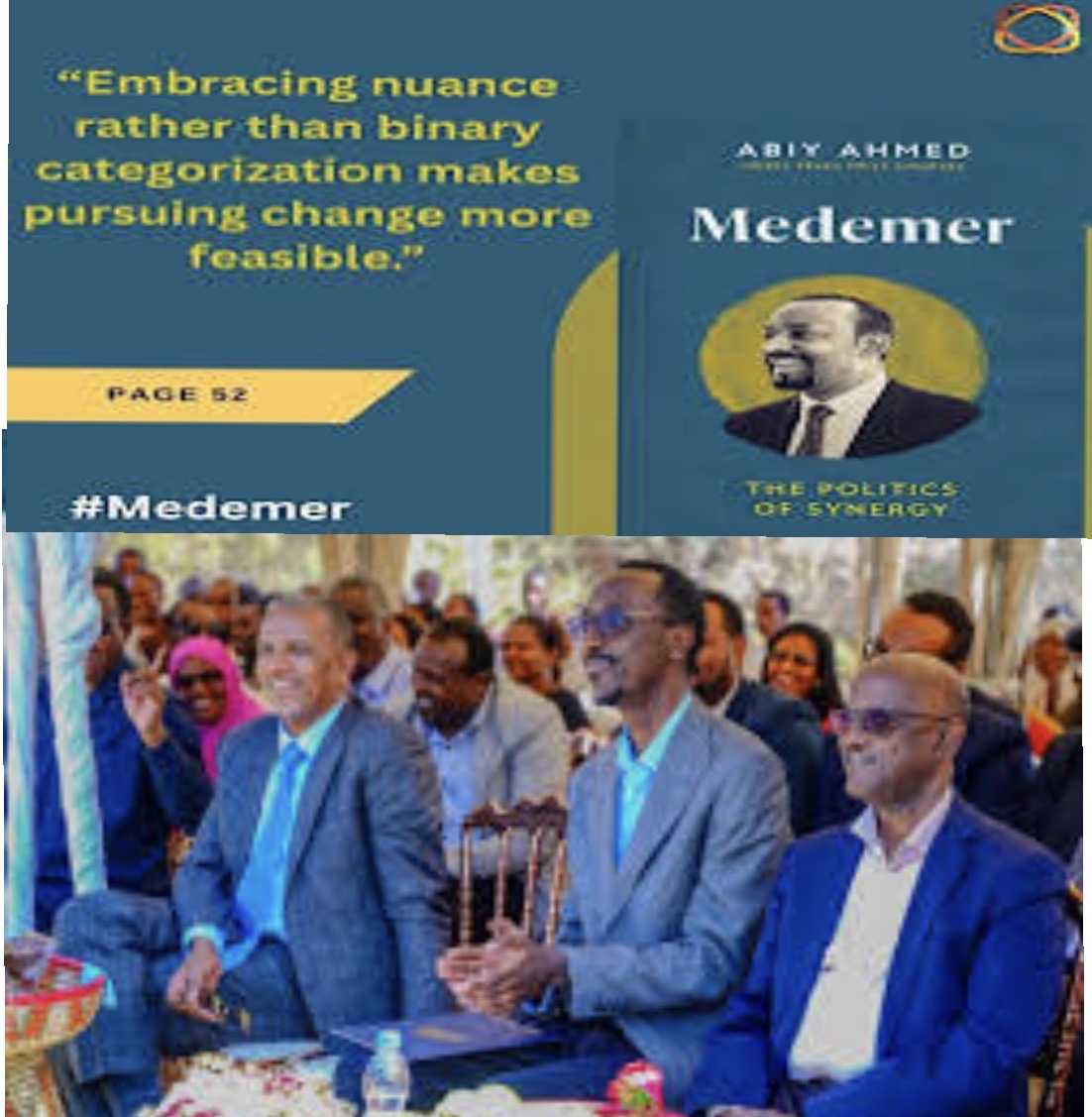
By. Abdirezak Sahane Elmi
In the annals of international relations, moments of profound national transformation are rare. They require a confluence of visionary leadership, institutional revitalization, and a geopolitical landscape ripe for realignment. Today, under the strategic leadership of Prime Minister Dr. Abiy Ahmed and the meticulously executed foreign policy of a rejuvenated Ministry of Foreign Affairs (MFA), Ethiopia is experiencing such a moment. We are witnessing not merely a series of diplomatic engagements, but the meticulous construction of a new global identity, one built on the principles of Medemer (synergy), sovereign agency, and bridge-building diplomacy. This is the story of a nation, once perceived through the narrow prism of internal challenges, now actively and successfully recasting itself as an indispensable, trusted, and unified actor on the world stage.
The Foundation: Visionary Reform Meets Patriotic Execution.
The journey to this diplomatic zenith was neither accidental nor instantaneous. It began with the reformist agenda of PM Dr. Abiy Ahmed, who identified the modernization of key state institutions as a cornerstone of national renewal. The Ministry of Foreign Affairs, the primary interface between Ethiopia and the world, was rightly prioritized. A “strategic institution-building process” was initiated, aiming to transform the MFA into a nimble, technologically adept, and strategically foresighted apparatus capable of advancing Ethiopia’s interests in a complex 21st-century landscape.
However, as with any profound transformation, the gestation period between structural reform and tangible outcome is critical. The initial phase, while laying necessary groundwork, faced the inevitable challenges of implementation at the ministerial level. The vision was clear, but its full potential awaited the arrival of leaders whose competence was matched by an unyielding patriotic fervor. This is the pivot upon which Ethiopia’s recent diplomatic success turns. The current leadership combination at the MFA represents more than a change of personnel; it embodies the perfect synergy of strategic understanding, operational diligence, and a profound love for country. They are the vital translators, converting the philosophical framework of Medemer, which emphasizes collective synergy and inclusive partnership into a actionable foreign policy doctrine and, ultimately, into a cascade of diplomatic victories.
Their mandate is clear: to deploy Ethiopia’s diplomatic corps not as passive representatives, but as proactive advocates, negotiators, and relationship-builders. This shift from a reactive to a projective diplomatic posture is the engine behind the current successes. It is a leadership dedicated not to managing Ethiopia’s global relations, but to actively shaping them in the nation’s favor.
A Symphony of Engagement: The Unprecedented Diplomatic Offensive of Late 2025.
The proof of this transformative leadership is etched in the diplomatic calendar of late 2025, a period so dense with high-level engagement that it seemed to redefine the very passage of diplomatic time. The symbolic observation that “November lasted only two weeks” before giving way to a December brimming with breakthroughs is a powerful testament to this new momentum. This was not business as usual; this was a deliberate, confident, and highly orchestrated diplomatic offensive designed to reposition Ethiopia in the global consciousness.
The scope and strategic selection of partners during this period are analytically stunning. Engaging with 41 countries in focused discussions is a logistical and intellectual feat. But more importantly, it reveals a sophisticated, multi-vector foreign policy that refuses to be confined by old binaries or forced choices.
1. The Global Power Dialogue: Simultaneously deepening ties with all permanent members of the UN Security Council, China, the United States, Russia, the United Kingdom, and France, is a masterclass in balanced, non-aligned engagement. It signals that Ethiopia is not a client state but a sovereign partner, willing to collaborate on shared interests with each, from infrastructure and development with China, to security cooperation and trade with the US, to strategic consultations with Russia. This approach commands respect and maximizes national room for maneuver.
2. The Economic Partnership Vector: Parallel overtures to economic powerhouses like Germany, South Korea, Indonesia, and South Africa demonstrate a sharp focus on the core imperative of national development. These engagements move beyond political dialogue to concrete discussions on technology transfer, foreign direct investment, market access, and knowledge sharing. They are directly tied to job creation, industrial growth, and the transfer of critical skills to the Ethiopian workforce.
3. The Anchor of Regional Integration: No foreign policy can succeed if it neglects its own neighborhood. The intensified engagements with Kenya, Somalia, Djibouti, and other regional partners reaffirm Ethiopia’s unwavering commitment to the stability and prosperity of the Horn of Africa. This is the bedrock of its security and a prerequisite for its economic ambitions, particularly regarding port access and regional trade corridors.
The Deeper Meaning: Showcasing Capability, Trust, and Universal Partnership.
The sheer volume of these interactions is impressive, but their true significance lies in the qualitative message they broadcast to the world.
· Diplomatic Capability Reaffirmed: Executing this scale of high-stakes diplomacy requires a ministry operating at peak efficiency. It showcases a diplomatic corps with deep expertise, meticulous preparation, and the ability to manage multiple complex dialogues simultaneously. It tells the world that Ethiopia’s foreign service is back, and it is elite.
· Foreign Policy Acceptance: The willingness of such a diverse array of nations from superpowers to emerging economies to engage at this level is a resounding endorsement of Ethiopia’s foreign policy direction. It validates the Medemer approach of collaboration and mutual benefit. The world is not just listening; it is responding positively.
· The Emergence of the “Trusted Ally”: Perhaps the most crucial achievement is the restoration and enhancement of Ethiopia’s reputation as a reliable, consistent, and principled partner. In a world fragmented by rivalry, Ethiopia is positioning itself as a rare entity: a nation that can talk to everyone, uphold its commitments, and serve as a bridge in a divided international system. This makes Ethiopia not just a participant in global affairs, but a sought-after facilitator and ally.
A Call to Unity: Patriotic Duty in the Age of Information.
Such monumental achievements on the global stage must be met with equal responsibility on the domestic front. The dedicated patriots steering our foreign policy are fighting to open doors, attract investment, and secure our nation’s standing. It is the sacred duty of every Ethiopian citizen to protect and amplify these gains.
We must, therefore, issue a solemn and urgent call: the era of destructive internal propaganda must end. Narratives designed to poison national unity, distort economic progress, and smear our cultural and social fabric for narrow political ends do not merely play to a domestic audience. In the digital age, they are weaponized by external actors and directly damage the nation’s dignity, undermine investor confidence, and erode the very international trust our diplomats are working so tirelessly to build. We cannot seek to be a pillar of stability abroad while willfully sowing discord at home.
Our diversity in ideology, faith, ethnicity, and perspective, is a historical fact. But it must be transcended by a higher, unifying truth: our shared Ethiopian citizenship. We are all shareholders in this ancient and resilient nation. Our common project must be the pursuit of the common good, the construction of a politics that benefits all, and the mature understanding that in a democracy, we can “agree to disagree” without threatening the very survival of the state. The diplomatic successes we celebrate are not victories for a single party or group; they are assets belonging to the entire Ethiopian people, secured today to ensure the prosperity and security of generations to come.
Conclusion: The Dawning of a Synergistic Era:
The current diplomatic triumphs are not a destination, but a powerful confirmation that Ethiopia is on the right path. They are evidence that when visionary national leadership is combined with patriotic ministerial excellence, the results can redefine a nation’s trajectory. We stand at the threshold of a synergistic era, where internal renewal and external engagement fuel one another.
Let us, therefore, offer our profound appreciation to the current leadership of the Ministry of Foreign Affairs. Your skill, dedication, and love for Ethiopia are shining through in every capital where our flag flies. We encourage you to double your efforts, knowing a grateful nation supports you. Let us also, as a united citizenry, resolve to be worthy of this moment on the world stage. Let us champion narratives of unity and progress, defend our nation’s dignity, and build from within the strong, cohesive society that our diplomats so ably represent abroad. For the sake of our children and the glory of Ethiopia, let us ensure that this new dawn of diplomacy is but the beginning of a lasting renaissance.
By. Abdirezak Sahane Elmi
Former Government Official, writer and Geopolitical analyst.
Abdirezaksahane15@gmail.com